

Empowering childcare educators to address domestic violence
October 8, 2026
Earlier this year, CatholicCare’s primary prevention team collaborated with council run childcare centres across the Central Coast to help combat domestic and family violence. Through targeted workshops, educators were equipped with essential knowledge and strategies to detect early signs of abuse and how to respond with compassion, confidence and care.
The idea for these workshops emerged from a clear and growing concern – childcare educators were encountering families affected by domestic violence but lacked the training and guidance on how to respond. Reports from centres revealed that educators often felt helpless – unsure of what to say, who to refer to or how to offer support without crossing professional boundaries.
It was a need echoed by Councillor Leah Haydon, who had been hearing similar concerns. She approached CatholicCare’s team with a proposition – “Can we fund CatholicCare to upskill our staff?” Her commitment to addressing the issue was instrumental in scaling the initiative across all council run childcare services on the Coast.
Traditionally, CatholicCare’s Domestic and Family Violence education had been delivered to individual centres or small groups. This time, however, the initiative was taken to a whole new level. Workshops were conducted for both the northern and southern regions of the Central Coast, ensuring that every council run centre could participate.
The sessions were interactive and thought provoking. One exercise challenged participants with the question, “Is physical violence the most serious form of abuse?” Educators physically moved to different sides of the room to reflect their views, prompting discussions about emotional, psychological and financial abuse – often more hidden, but equally damaging.
Real life scenarios were shared, like a chilling account where a child arrived at a centre and said, “Half of mummy’s head is ripped off.” Educators needed tools not only to handle such disclosures safely, but also to respond with the empathy and reassurance children so desperately need.
“Educators don’t need to be Domestic and Family Violence specialists – but they are uniquely positioned to make a difference,” says Domestic Violence Project Specialist Danielle. Their daily connection with children and families allows them to observe subtle warning signs. As Danielle puts it, “Our childcare educators are the angels who look after children. If kids are going through horrendous times at home, educators can’t fix that – but they can offer love, kindness and a safe attachment. That makes all the difference.”
The workshops reinforced the critical importance of that attachment and the lasting impact it can have. Many educators were moved, with several expressing after the session, “I didn’t realise the impact I could have on children.”
Another core theme of the training was understanding the role of gender and power dynamics in domestic and family violence. Participants were encouraged to reflect on how rigid gender stereotypes can perpetuate cycles of violence. Teaching gender equality from an early age was highlighted as a long-term strategy in preventing violence and building a culture of respect.
One powerful takeaway was that violence against women is not random – it is rooted in systems of inequality and discrimination. Addressing those systems, even in subtle ways through everyday interactions with children, has the potential to create generational change.
A comprehensive support pack with service contacts was praised by directors and educators alike. Clips like Dr Bruce Perry’s video on brain development made the lasting neurological impacts of trauma real and urgent.
Some educators quietly disclosed that they were experiencing violence themselves. The workshops became a moment of validation and hope for them too.
Due to the success and demand, our team has been invited to deliver more sessions. As one passionate young educator, Tyler, asked, “Where can I do more of this? I’m so interested to learn more.”
The work isn’t finished. But this initiative has shown that primary prevention is possible – and it starts with awareness, education and community care. Childcare centres are sanctuaries, lifelines and potential catalysts for change.


More news stories like this one

John’s journey from blame to accountability
When John first stepped into our Back on Track Men’s Behaviour Change Program, he didn’t come willingly and was a long way from accepting the impact of his violent behaviour.
Read More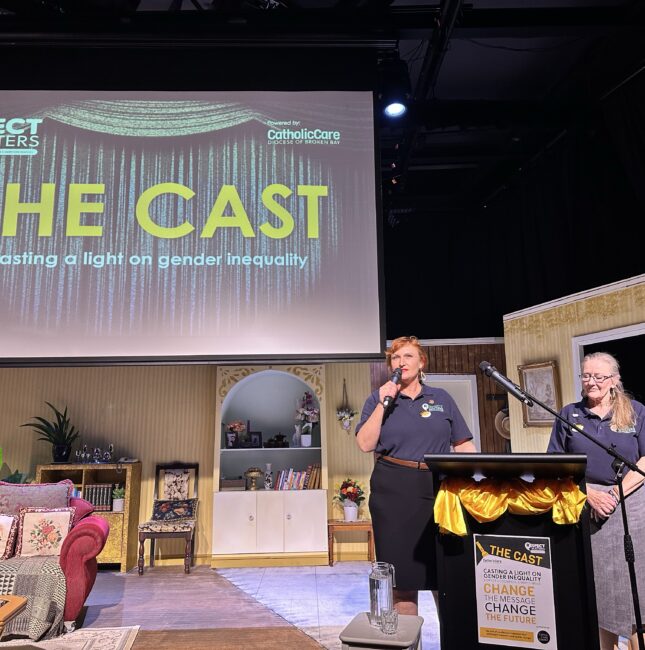
Casting a light on the drivers of domestic and family abuse
Boys don't cry. Toughen up. Be a man. CatholicCare's Respect Matters team knows there is a direct line between casual phrases like these and the domestic violence upending families across our community.
Read More
Nina reclaims her life after violence
For Nina, her workplace became more than just a job, it was a rare pocket of safety in an otherwise controlled and frightening world. It was the only place where she could speak openly with her Case Worker, free from surveillance and intimidation.
Read More