

Emily’s small steps to big changes
July 13, 2026
When 11 year old Emily first came into contact with CatholicCare’s Intensive Family Preservation (IFP) program, she wasn’t going to school. She wasn’t speaking. She was barely leaving the house. Her sleep cycle was so disrupted that, according to her parents, it would “reset every five days” – a sign of just how far her life had spiralled out of rhythm.
“There were hygiene issues, she hadn’t been to school for five terms, and she wasn’t talking at all,” recalls Zara, the CatholicCare Case Worker assigned to support Emily and her family. “At one point she was showering just a couple of times a month.”
Emily, diagnosed with autism level 2 in 2020, was experiencing severe school refusal and escalating emotional distress. If she did manage to attend school, things often deteriorated quickly. Eventually, CYMHS (Child Youth Mental Health Service) had to involve the police for support, and Emily required hospitalisation for mental health reasons. It was a concerning situation. But what followed was a powerful story of patience, perseverance and the impact of wraparound support.
Referred by the Department of Communities and Justice (DCJ) in October 2024, CatholicCare’s brief was clear – help Emily return to school and build formal supports around her autism and mental health.
“At first, Emily wasn’t leaving the house at all,” Zara explains. “She wouldn’t speak, and there was a complete lack of routine at home.”
Language and cultural barriers added layers of complexity. Emily’s family, a Mandarin speaking household, had limited understanding of the autism diagnosis and the support systems available. “Initially, one of the greatest barriers was her parents’ hesitation to accept the diagnosis,” Zara says. “But that’s one of the areas where we’ve seen the most growth.”
Zara coordinated culturally appropriate support, including Mandarin speaking occupational therapists and interpreters for medical and educational appointments. “We even used flash cards with English cues, Mandarin translations, and pictures to help Emily communicate when she wasn’t speaking,” Zara shares.
Emily’s journey back to school didn’t happen overnight. In fact, she didn’t attend at all during Term 4 in 2024. But behind the scenes, critical groundwork was laid. Zara and the CatholicCare team arranged regular attendance review meetings with Emily’s independent school. They helped set small, achievable attendance goals and worked closely with Emily’s parents to establish realistic expectations.
“We supported them in accessing the NDIS, submitted an access request, and began collecting the clinical assessments needed to build a case for long-term support,” Zara says.
One significant breakthrough came when Emily agreed to work with an occupational therapist. “She stayed and engaged for the whole time. That was off the back of her starting to go out more, talking more, and establishing a routine at home. She’d even started swimming lessons.”
Despite a hopeful start at her original school in Term 1, 2025, Emily faced another hurdle. After just a few days, she refused to return.
“We’d already discussed that if things didn’t work out, we’d explore a different school environment,” Zara explains. Though the family initially preferred independent schooling, they made the huge decision to transition Emily to a public school. “That was a big shift, especially considering their values around academic achievement. But they saw that the public system offered more of the targeted support Emily needed.”
Emily’s new school crafted a gradual return plan. Today, she stays until recess and has transitioned to doing more of the same academic work as her peers. She was recently accepted into a dedicated support class for students with a history of attendance challenges – a class with only 14 students, two teachers, and two learning support staff.
“It’s a much more flexible, supportive environment,” Zara notes. “This setting is really tailored to children like Emily, and it’s exactly what she needs right now.”
Emily’s parents – once hesitant and uncertain – are now fully engaged in her support network. “They’ve come such a long way,” Zara says. “They understand her diagnosis now, they’ve adjusted their expectations, and they’re actively involved in her NDIS planning.”
From a girl who once barely left her room, Emily is now attending school 75% of the time based on her current plan. She’s developing friendships. She has a much better sleep routine and she’s also started on medication to help with sleep and anxiety.
“There’s still a long road ahead,” Zara admits. “She’s not really speaking with her peers or teachers yet, but her progress is undeniable.”
Emily’s story is an example of what’s possible when wraparound supports, cultural sensitivity, and family involvement come together. From a place of deep struggle, she and her family are moving forward, bit-by-bit, step-by-step.


More news stories like this one

Empowering childcare educators to address domestic violence
Earlier this year, CatholicCare’s primary prevention team collaborated with council run childcare centres across the Central Coast to help combat domestic and family violence.
Read More
John’s journey from blame to accountability
When John first stepped into our Back on Track Men’s Behaviour Change Program, he didn’t come willingly and was a long way from accepting the impact of his violent behaviour.
Read More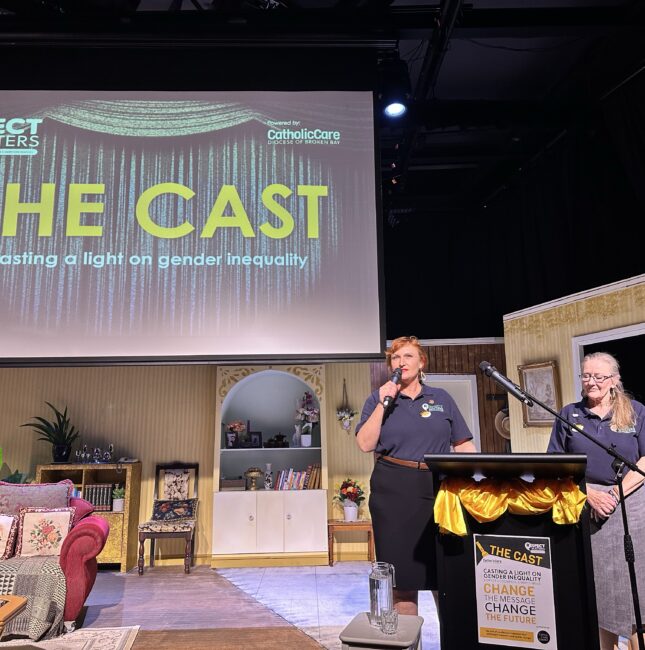
Casting a light on the drivers of domestic and family abuse
Boys don't cry. Toughen up. Be a man. CatholicCare's Respect Matters team knows there is a direct line between casual phrases like these and the domestic violence upending families across our community.
Read More