Casting a light on the drivers of domestic and family abuse
October 7, 2026
Boys don’t cry. Toughen up. Be a man. Most of us have heard these phrases so many times we no longer notice them. But CatholicCare’s Respect Matters team knows there is a direct line between casual phrases like these and the domestic violence upending families across our community. In the last 12 months alone, 1,910 domestic violence related incidents were reported on the Central Coast, a figure that, given up to 60% of cases go unreported, likely tells only part of the story. That link between everyday language and the harm it can help reproduce is what The Cast, a series of short clips driven by CatholicCare and supported by a grant from Central Coast Council, sets out to explore.
Ninety Central Coast locals, ranging in age from 7 to 83 and drawn from diverse working and cultural backgrounds, were presented with a series of these familiar phrases and asked to choose the one that resonated with them the most, then speak it to camera. Everyone involved shared the same motivation: an interest in being part of the project and a wish to see change. The result was launched on 28th July at Red Tree Theatre in Tuggerah, with the Hon. Jodie Harrison, Minister for the Prevention of Domestic Violence & Sexual Assault, in attendance.
The driving force behind The Cast was Nellie Srisurapon, CatholicCare’s Domestic Violence Specialist, who brings more than 20 years of frontline case management and advocacy experience with migrant and refugee background communities. “The dynamic flow of it all is thanks to her,” says Danielle Habib, who leads CatholicCare’s Respect Matters team.
Danielle says the project set out to name something that usually goes unnamed: the everyday language that shapes how we understand gender, long before anyone gets close to a crisis. For an organisation grounded in the belief that every person is deserving of dignity and respect, that work matters deeply.
“Every person can do something, and it starts with something as simple as the language we use,” Danielle says. Phrases such as “toughen up” and “be a man” might sound harmless, but they set rigid expectations for how men and women are supposed to behave, and those expectations don’t stay contained to a joke or a passing comment. Promoting rigid, hierarchical gender stereotypes helps reproduce the very social conditions that underpin violence against women, and stereotypes of masculinity in particular play a direct role in driving men’s violence against women.
That’s the discourse The Cast set out to interrupt. “The purpose was to cast a light on these messages and beliefs that are so woven into the fabric of our society,” Danielle says.
The Cast builds on a much broader body of primary prevention work CatholicCare has established on the Central Coast, including securing $581,000 in funding over three years through the NSW Government’s Primary Prevention grants program, part of the first-ever coordinated, statewide investment in this kind of work. It also builds on Project Respect, CatholicCare’s six-week schools program on respectful relationships, healthy masculinity, mental health and consent, and years of training delivered to recreational and sporting clubs, workplaces, childcare centres, and frontline domestic violence and family support workers.
The idea of the active bystander sits at the centre of all of it. Danielle says changing culture isn’t only about big interventions. It’s about people noticing when something isn’t right, and being willing to say something. “The behaviour you walk past is the behaviour you accept,” she says.
For Danielle, that principle isn’t theoretical. She recalls the night her then 15-year-old daughter came into her room just before 9pm. “I need to speak now,” she said. Her daughter showed her a Snapchat feed of a friend with a bottle of bleach, apologising to his mum and dad. Danielle rang 000 and told the operator it looked like he may be consuming a bottle of bleach. Police and an ambulance were sent directly to the scene, and the boy was rushed to hospital and taken into intensive care.
What mattered most that night, Danielle says, was that her daughter didn’t scroll past. “You are always saying, if you see something, do something,” her daughter told her afterwards. “I wouldn’t have done that if we hadn’t had all these conversations.” It’s the same instinct Danielle hopes The Cast will build in everyone: noticing the small things, and having the confidence to speak up.
As domestic violence advocate Rosie Batty has said, “Whether you sit in a boardroom, a classroom or a seat on the bus, you have influence and you can contribute to the seismic shift towards a world free from violence.”
“You are part of this community, and you can make a difference,” Danielle says. “Speak to someone if you don’t know what to do, because you’re not in this alone. We are a community, and your voice matters.”


More news stories like this one
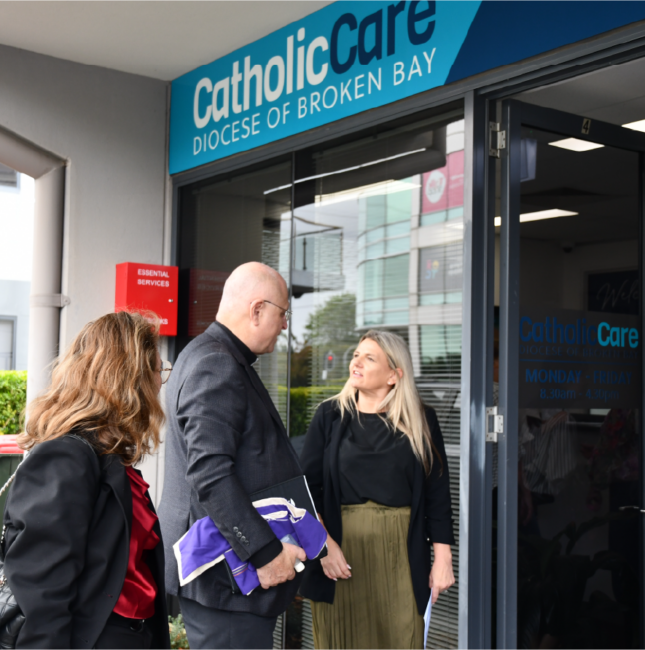
Our new Family Centre in Frenchs Forest
Every part of the new CatholicCare Northern Beaches Family Centre in Frenchs Forest has been designed around the families who come to us in their most difficult moments. And everyone is welcome!
Read More
Empowering childcare educators to address domestic violence
Earlier this year, CatholicCare’s primary prevention team collaborated with council run childcare centres across the Central Coast to help combat domestic and family violence.
Read More
John’s journey from blame to accountability
When John first stepped into our Back on Track Men’s Behaviour Change Program, he didn’t come willingly and was a long way from accepting the impact of his violent behaviour.
Read More